
Leah Niederhausen
“How can we archive restitution?”
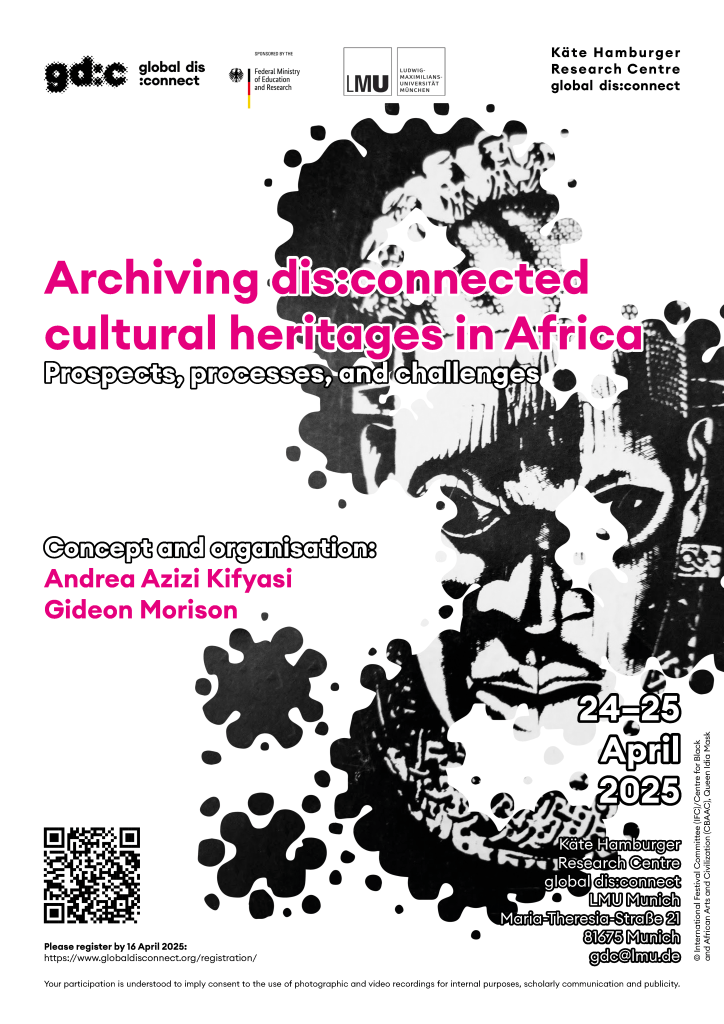
This was one of the questions I had the privilege of discussing during the truly inspiring workshop “Archiving Dis:connected Cultural Heritages in Africa: Prospects, Processes and Challenges”, hosted by the Käte Hamburger Research Centre global dis:connect at LMU Munich.
Archival Silences and Pan-African Legacies
Throughout our conversations on archives of African cultural heritage, we kept coming back to two key themes: archival silences and Pan-Africanism, especially the archival legacies of Pan-African cultural festivals. Whether we examined ethnographic collections (Dr. Valence Silayo), missionary archives (Dr. Nancy Rushohora), or the Calabar Slave Museum (Prof. Patrick Ebewo), a shared insight emerged: archives both silence narratives and generate narratives of silence. These silences shape how African cultural heritage is currently represented—for instance, in AI-driven reconstructions, as discussed by Mohamad Fareed. At the same time, post-colonial cultural festivals produce narratives that show transformative potential (Rethabile Malibo) and possibilities for curatorial interventions (Naima Hassan). Central to this is the work of the Centre for Black and African Arts and Civilization (CBAAC), presented by the Hon. Aisha Adamu Augie and Jubril Adesegun Dosumu, which remains a vital resource for reimagining archival futures.
My Contribution: Archival-Museological Dis:connections
In my own contribution, “Museum object here, archival record there,” I discussed archival-museological disconnections in the restitution of the Bible of Hendrik Witbooi (1830-1905), a leading Nama anti-colonial resistance fighter. After being held in a German museum collection, the Bible was restituted in 2019 and transferred to the National Archives of Namibia. This transfer highlights how institutional narratives of archives and museums frame not only our understanding of cultural belongings and archival records but also of mass violence, structural injustice, and the demand for repair.
Beyond the Nation-State
One central takeaway from the workshop was the connection between archival silences and Pan-African cultural festivals, and the claim it makes: questions of archiving, justice, and knowledge production must go beyond the nation-state. We discussed the importance of sub-national and pan-national archiving initiatives that bridge local and global knowledge systems. This shift in perspective draws attention from the what to the who: from “What is to be archived?” to “Who archives whose knowledge for whom?”
Ongoing Processes of Archiving and Restitution
Coming back to my initial question of how we can archive restitution, one point became clear: matters of ownership and access do not end with the moment of return. To the contrary, like archiving, restitution is an ongoing process of knowledge production that negotiates human dis:connections in the present. To quote my dear colleague Dr. Nancy Rushohora “What are we trying to repair?”

 Homepage