
Nicole L. Immler is historian, working on the afterlife of historical injustice (World War II, colonialism), exploring why the past still matters. She is professor of Historical Memory and Transformative Justice at the University of Humanistic Studies, linking in her work History, Transitional Justice, Memory Studies, and Oral History.

DIALOGICS OF JUSTICE
In the ‘Dialogics of Justice’, Nicole Immler studies several recognition claims addressing colonial wrongs, exploring the question: what is meant by the notion of recognition and repair? Having identified certain problems in her earlier research on the Indonesian-Dutch ‘Rawagede case’ (Immler 2016, 2018), she aims to substantiate her findings via comparative research, including Dutch (Indo European, Caribbean and Antilleans community) and international cases (UK/Kenia, European countries/CARICOM) in the analysis, to categorize the problems and identify alternative solutions.
With her earlier research Narrated (In)Justice, exploring how (in)justice is re-narrated across generations, she was Marie Curie Fellow in the program ‘Understanding the Age of Transitional Justice’ at the NIOD, Institute for War, Holocaust and Genocide Studies. Exploring the ‘Rawagede case’, a court case on Dutch war crimes in Indonesia’s war of independence, resulted in a prize-winning article (BMGN 2018). Beforehand, in her PhD, a meta-biography on Ludwig Wittgenstein, she theorized the concept of family memory (2010), further developed in her Post-doc The afterlife of restitution when examining the dynamics between family memory on the Holocaust and reparation politics (2012).
Contact: n.immler@uvh.nl
PUBLICATIONS
Herstel als maatschappelijke opdracht: zichtbare transformatie van relaties
The Child Benefits Scandal harmed individuals, families, and social relationships. Despite significant investments in repair, many victims still find these efforts inadequate, partly due to the lack of a systemic, society-wide approach. This article explores societal repair using theories of transformative justice, resonance, and the justice continuum, presenting repair as a multi-level process. It proposes…
Lees verderHistorical abuse in Dutch Catholic institutions: A qualitative evaluation of victim-survivors’ experiences with redress procedures
This study examines survivors’ experiences with redress mechanisms for historical abuse by Catholic clergy in the Netherlands, showing that empathetic, participatory procedures fostered greater recognition and agency than rigid, adversarial processes.
Lees verderThe Multivoiced Archive: Connecting Oral Histories of Historical Injustices
How to make the archive speak? This entry by Nicole Immler is about rethinking more deeply the oral history archive—an archive in which hitherto “unheard voices” will be voiced in ways they might more easily and differently listened to. This means going beyond being solely an academic depository, but being dialogical in multiple ways: the…
Lees verderMEDIA

Interview on the meaning of freedom as a scientist and human being
1/6/2025 ‘Erkenning van het verleden biedt vrijheid voor de toekomst’ – Vrij Nederland
‘Recognition of the past offers freedom for the future.’ That is Nicole Immler’s position in the conversation with Annemiek Leclaire for Vrij Nederland about the meaning of freedom as a scientist and as a human being.
Lees verder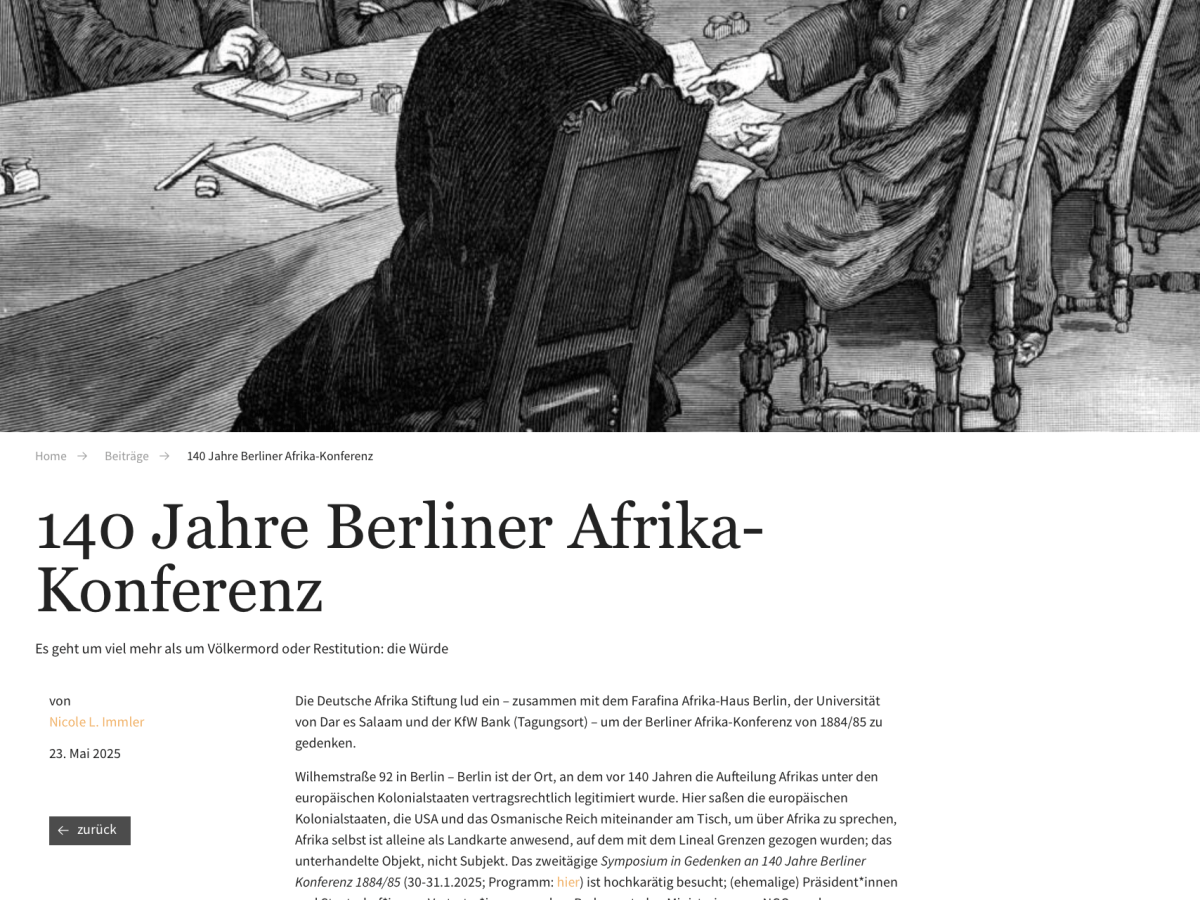
140 Jahre Berliner Afrika-Konferenz
23/5/2025 – ‘140 Jahre Berliner Afrika-Konferenz’ – Zeitgeschichte Online
Report by Nicole Immler on her visit of the Africa Conference in Berlin. It is about much more than genocide or restitution: dignity – at the conference commemorating the Berlin Africa Conference of 1884/85. To this day, the conference continues to shape European thinking about Africa…
Lees verder
Podcast Dialoog: De Geschiedenis is voorbij, de Dialoog niet.
7/4/2025 ‘De Geschiedenis is voorbij, de Dialoog niet’ – Podcast Dialoog
In this podcast episode by Stichting Dialoog NJI, Nicole Immler discusses the impact of trauma and the importance of engaging in dialogue. This is difficult, but according to Immler, you don’t always have to agree to make progress. Listening and self-reflection are key.
Lees verder Homepage