
Niké presented some first reflections from the Dialogics of Justice project on the transnational dynamics in local courts. She argued that from the perspective of plaintiffs, the dynamic between the international and local is second nature – after all, their search for justice often transcends boundaries in time (intergenerational) and space (cross-national, like in the […]
Lees verder02-03/05/2024 – Reimagining Victims’ Reparation Global Network (RVRGN): “Reimagining reparation as social repair. A Dialogics of Justice perspective.”
Nicole, Siri and Niké participated in the second workshop of a newly established network on re-imagining victims’ reparations. Sandra Rios Oyola invited this group of international scholars to come together in a beautiful medieval hall at University College Roosevelt. Over two days, discussing multiple cases and theoretical frames, we exchanged ideas on how reparations can […]
Lees verder20-22/03/2024 – INEA Congress Intercountry adoption: creating a multiperspective narrative
From March 20 until March 22 the first (international) INEA Congress took place. The theme of this three-day congress was: Intercountry adoption: creating a multi-perspective narrative. On day one Nicole Immler participated in the opening paneldebate, following-up on the keynote speaker Elvira Loibl. The paneldebate discussed what is meant by ‘Transformative Justice’ and in which […]
Lees verder13/03/2024 – The Justice Visions Conference at the University of Ghent
How to bring scholars and practitioners from the Global South and North in the field of Transitional Justice in an exciting dialogue? The Justice Visions conference at the University of Ghent focused on questions on victim’s participation, mobilization and – importantly – resistance; such as the focus fom Luke Moffet’s presentation. Niké Wentholt, Naomi Ormskerk and […]
Lees verder
Radio interview on the independence of Bosnia and Herzegovina, and the upcoming European elections
On March 1, 2024, Niké Wentholt was interviewed for an hour about Independence Day in Bosnia.
On June 3, 2024, Niké spoke about Bosnia and Herzegovina in light of the upcoming European elections.

Call on Dutch institutions for higher education to speak out on (de)humanization in the face of the violence in Palestine and Israël
27/10/2023 ‘Hamas-Israël conflict moet studenten leren niemand te ontmenselijken’ – Trouw
‘Wees niet bang om ‘partij te kiezen’ gericht op humanisering’ – Nieuw Wij
In this opinion piece Siri Driessen, Nicole Immler, Obiozo Ukpabi and Niké Wentholt called on Dutch institutions for higher education to take a stand against dehumanization in the face of terrorist attacks and genocidal violence.
Lees verder
Meerstemmigheid in erkenning van onrecht
Dagmar Punter interviewed the DoJ team on the Dialogics of Justice project, and multivoicedness in the recognition of injustice.
Lees verder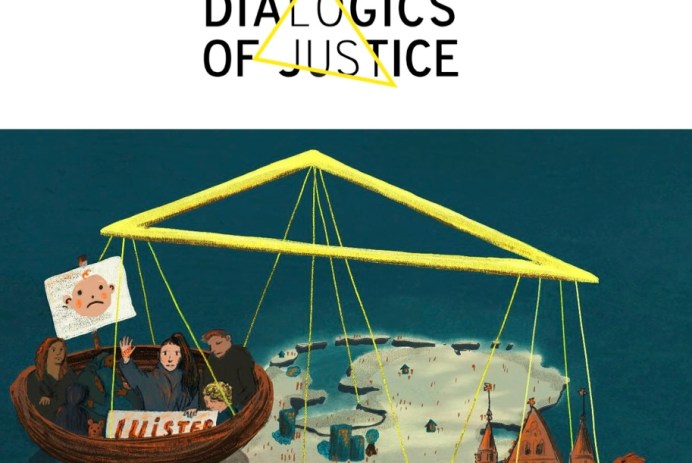
Herstel als maatschappelijke opdracht. Zichtbare transformatie van relaties.
This is a discussion note by Nicole Immler and Niké Wentholt on the Child Benefit Affair. They discuss reparation as a social task and the visible transformation of relationships.
Lees verder01/06/2023 – Law and Society Association Annual Conference. San Juan.
At the annual conference of the Law and Society Association, titled ‘Separate but Inequal,’ Niké Wentholt presented the Dialogics of Justice project and was discussant in a final panel on transitional justice. Important issues were raised by the audience on the thickness of social representations, impeding true justice and recognition, and the colonial nature of […]
Lees verder12/05/2023 – Legal Research Master Conference. University of Utrecht
Niké Wentholt held the keynote on the 2023 Law Research Master Conference. Connecting the conference themes Responsibility: Past, Present, and Future, she argued that historical injustice cases ask us the same questions as cases of systemic injustice that emerge today. A dialogical approach to responsibility would thus mean to question how to restructure social relations […]
Lees verder Homepage