
Relational approaches have become increasingly prominent in the social sciences and humanities, resulting in the so-called ‘relational turn’ (Dépelteau 2013). Rather than focusing on isolated actors or events, such approaches seek to understand phenomena through their relations: between people, practices, institutions, histories, and systems of power. But what does it mean to work relationally in research? Dialogics […]
Lees verder23/1/2026 – Meeting RNW Oral History – The Multivoiced Archive: (How) Can We Make Oral History Archives Reparatory?
On Friday 23 January, the Oral History Network of the Huizinga Institute hosted an inspiring gathering at University Utrecht that brought together practices and reflections from Oral History, Transitional Justice, and Memory Studies around our project: The Multivoiced Archive. During the session we – Nicole Immler, Siri Driessen, Leah Niederhausen and Rosa Mul – presented our Multivoiced Archive project, […]
Lees verder10/12/2025 – Living Library: Voicing the human right for multivoicedness
Is there a human right for multivoicedness? From 12 November until 12 December 2025, Utrecht was dedicated to human rights. On Wednesday 10 December, International Human Rights Day, all initiatives came together in and around the Stadhuis of Utrecht. Living Library At a new edition of the Living Library by the University of Humanistic Studies, visitors met “living books” […]
Lees verder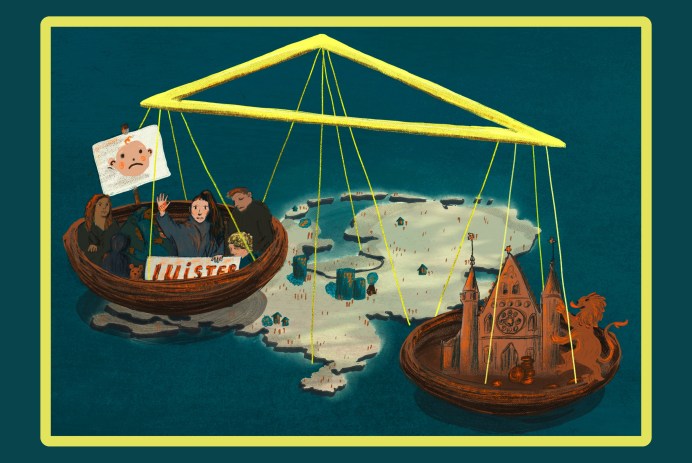
How to Repair Historical Injustice?
The Dialogics of Justice team is happy to announce and invite you to our final conference on April 15th-17th 2026. We have witnessed a rise in civil cases brought before Dutch district courts by people adversely affected by colonial violence, military missions, sexual abuse, and environmental harm. Can court cases truly challenge responsibility and bring about the recognition people long for? What does justice need to look like to become transformative for claimants and wider society?
Lees verder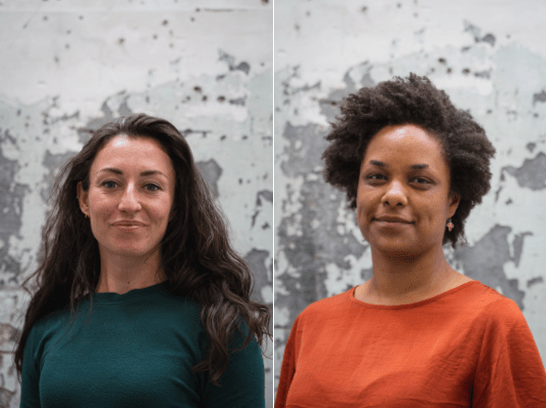
NWO grant for research into compensation payments by Shell to affected communities in the Niger Delta
Niké Wentholt and Obiozo Ukpabi will conduct research into so-called “transformative” justice in the Niger Delta. They have been awarded an NWO XS grant for this purpose.
Lees verder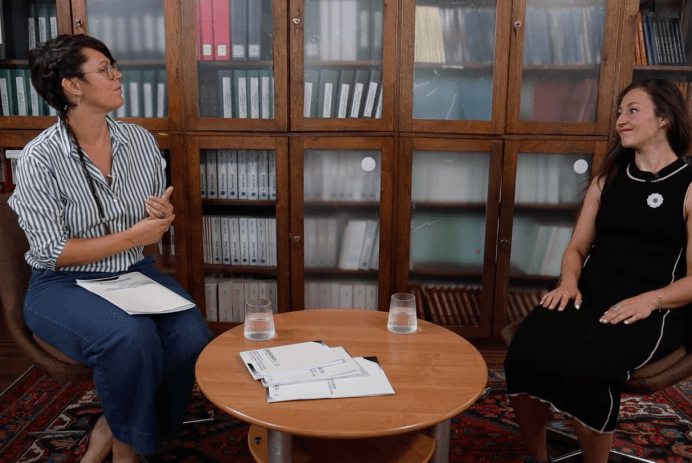
Podcast: Responsibility for the Future with Niké Wentholt
As part of her contribution to the 30 Years Srebrenica genocide-conference in Sarajevo in July 2025, Niké was invited to participate in the podcast UNSAJDER made for that important anniversary. In the podcast episode, she reflects together with presenter Tina Kalinić on questions of Dutch responsibility and epistemic justice in scholarly research on genocide.
Lees verder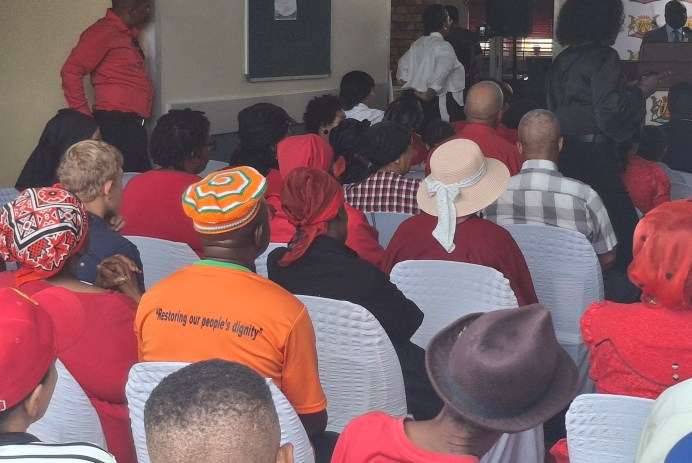
“What is the restitution that you are calling for?”: Hoe Namibische belongings uit Duitse collecties terugkeren
Restitutie is een sociaal proces op zich, dat bestaande machtsstructuren weerspiegelt en reproduceert. Terwijl het beweert schade te herstellen, kan het net zo goed nieuwe schade aanrichten door stemmen uit te sluiten en te marginaliseren. Tegelijkertijd betekent restitutie een vorm van thuiskomst. Dit wordt goed zichtbaar in de ervaringen van Namibische nazaten met processen van teruggave van rooferfgoed en voorouders door Duitse instituties.
Lees verder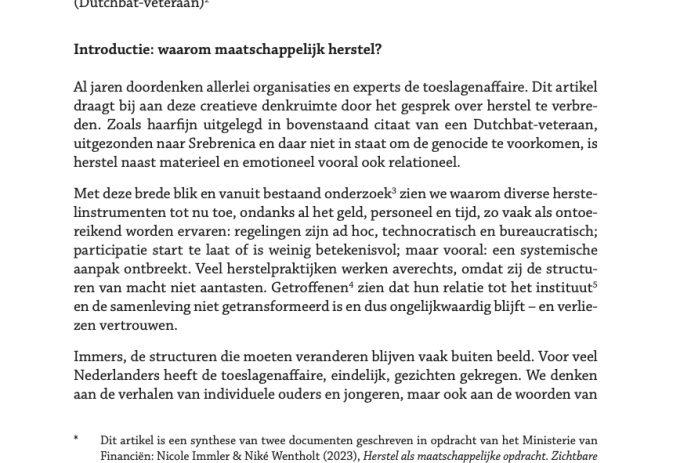
Herstel als maatschappelijke opdracht: zichtbare transformatie van relaties
The Child Benefits Scandal harmed individuals, families, and social relationships. Despite significant investments in repair, many victims still find these efforts inadequate, partly due to the lack of a systemic, society-wide approach. This article explores societal repair using theories of transformative justice, resonance, and the justice continuum, presenting repair as a multi-level process. It proposes three perspective shifts to address key obstacles and argues that repair requires the transformation of social relationships, making it a responsibility for society as a whole.
Lees verder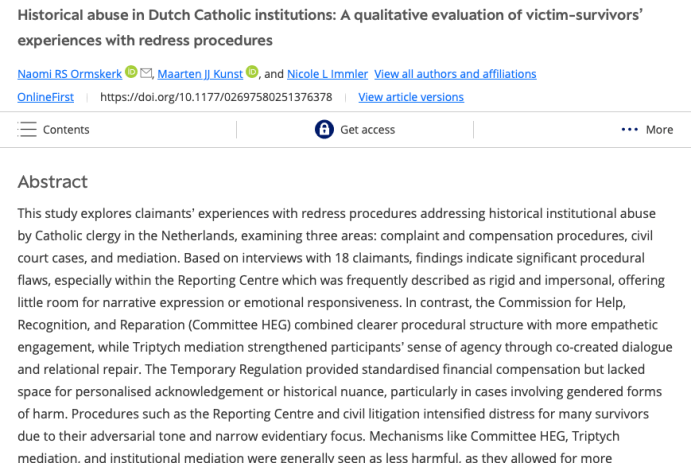
Historical abuse in Dutch Catholic institutions: A qualitative evaluation of victim-survivors’ experiences with redress procedures
This study examines survivors’ experiences with redress mechanisms for historical abuse by Catholic clergy in the Netherlands, showing that empathetic, participatory procedures fostered greater recognition and agency than rigid, adversarial processes.
Lees verder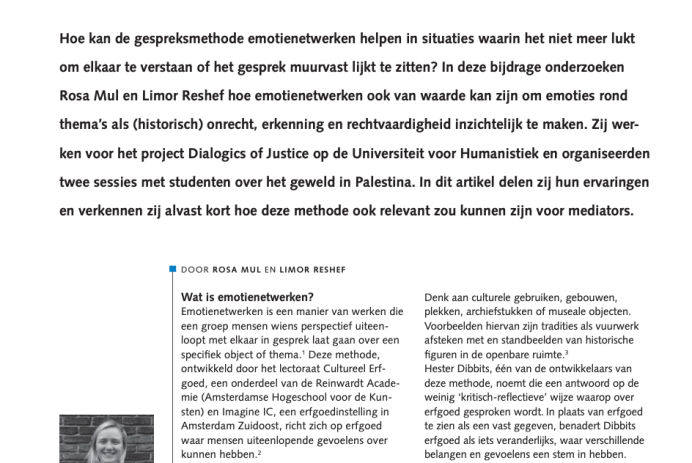
Emotienetwerken in tijden van ongemak
How can the conversational method of emotion networking help in situations where mutual understanding is no longer possible or the conversation seems to be stuck? In this article, Rosa Mul and Limor Reshef explore how emotion networking can also be valuable in providing insight into emotions surrounding themes such as (historical) injustice, recognition, and justice. They organized two sessions with students at the UvH on the genocide in Palestine and share their insights.
Lees verder Homepage